Tuesday, July 19, 2011

Where The Mountain Meets The Moon by Grace Lin


1.  Bibliography
Lin, Grace.  2009.  WHERE THE MOUNTAIN MEETS THE MOON.  New York:  Little Brown And Company Books For Young Readers.  ISBN 9780316114271

2.  Plot Summary
Minli spends everyday working besides her parents in the rice fields.  Their village is in the valley of fruitless mountain.  Every night her dad tells her stories about the Jade Dragon and the Old Man In the Moon.  "What kept Minli from becoming dull and brown like the rest of the village were the stories her father told her every night at dinner" (3).  Minli decides to go on a journey to find the Old Man in the Moon to bring prosperity back to her village.  She wants her family to be wealthy and not to have to work so hard. 

3.  Critical Analysis
The book is full of beautiful illustrations that are symbols of the Asian culture.  Each chapter begins with a picture in a single color.  The first chapter shows the young girl Minli skipping with flowers.  The rest of the book contains single illustrations that are in different chapters of the story and are also in color.  The facial features and hair color of the characters are Asian.  The clothing in the story is the traditional dress of the Asian people.  The environment where the story take place is in the Asian countryside, villages, and palaces.  The architecture of the building in the illustrations are filled with symbols and colors that are traditional to the Asian culture. 

The text of the story is also full of Asian cultural markers.  The characters in the story have Asian names for example Minli, Ma, Ba, A-gong, and Green Tiger.  These are only a few of the characters that have Asian names.  There are no physical descriptions of the characters to link them to their culture.  The language patterns, dialect of the language, and forms of address link the book to the Asian culture.  Ma and Ba are what the young girl calls her parents.  The food in the book gives away the culture.  The characters drink tea and eat a lot of white rice with chopsticks. The text is full of cultural markers.

This story is full of Asian cultural markers.  There is no presence of the American culture.  The identification of the Asian culture is very clear in the illustrations and the text of this book.

4.  Review Excerpts
SCHOOL LIBRARY JOURNAL starred review:  "The author's writing is elegant, and her full-color illustrations are stunning. Minli's determination to help her family, as well as the grief her parents feel at her absence, is compelling and thoroughly human."
BOOKLIST:  "*Starred Review* In this enchanted and enchanting adventure, Minli, whose name means “quick thinking,” lives with her desperately poor parents at the confluence of Fruitless Mountain and the Jade River. While her mother worries and complains about their lot, her father brightens their evenings with storytelling."
Newberry Honor Book

5.  Connections
Story to have children read when they are learning about Asian folklore and legends.
Other stories about Chinese folklore:
Chin, Oliver and Jennifer Wood.  THE YEAR OF THE DRAGON:  TALES FROM THE CHINESE ZODIAC.  ISBN 9781597020282
Wu, Faye-Lynn.  CHINESE AND ENGLISH NURSERY RHYMES:  SHARE AND SING IN TWO LANGUAGES.  ISBN 9780804840941
Yu, Mingmei.  CHINESE CHILDREN'S FAVORITE STORIES.  ISBN 9780804835893 

Apple Pie 4th Of July by Janet S. Wong

1.  Bibliography
Wong, Janet S.  2002.  APPLE PIE 4TH OF JULY.  Ill. by Margaret Chodo-Irvine.  New York:  Harcout Inc.  ISBN 9780152025434


2.  Plot Summary
Its the Fourth of July and nobody eats Chinese food on this American holiday.  The food at the restaurant is going bad while people buy everything but Chinese food.  "No one wants Chinese food on the Fourth of July, I say.  "My parents do not understand all American things.  They were not born here" (14).  By dinner time customers come to the store to buy dinner.  Eventually, it is time to close the store and watch the fireworks and eat apple pie. 

3.  Critical Analysis
The characters in the story are a Chinese family with a young daughter who run a convenience store that serves Chinese food.  The daughter keeps telling her family that people don't want Chinese food on an American holiday, but in the end of the story people want the food no matter what day it is.  In America all of the culture are one is the theme in the story.
The text does not include any descriptions of the skin colors or features of the characters.  The words in the story describe the food in the story which is a give away for the American Chinese culture.  "...Chow mein in our kitchen" (5).  There are no names of the characters in the story.  They are only mom, dad, and the daughter.  The language pattern and dialect are English.  The food in the story and reference to nobody wanting to eat Chinese food are the only indicators in the story that makes it part of the American Chinese culture.
The illustrations show the facial features and hair color to make the characters Asian.  They have tan skin and dark hair.  The environment that they live in and the clothing they wear are American.  There is nothing to distinguish them to make them their own culture.  The Chinese food in the pictures is a cultural marker that lets the reader see what culture the book is about.  The pictures illustrate the food in the story to show the difference between the American and Asian culture.

4.  Review Excerpts
PUBLISHER WEEKLY says:  "The author and artist teamed for Buzz return for this carefully honed story about a girl's experience as a first-generation Chinese-American. Readers first encounter the unnamed narrator as she looks unhappily out the glass door of her parents' market, open for business even on the Fourth of July. Hearing the "boom, boom, boom" of the approaching parade, sniffing the apple pie baking in a neighbor's..."
CHILDRENS LITERATURE remarks:  "In a lyrical look at a young Chinese-American girl's 4th of July in her family's convenience store, Wong paints a unique picture of the evolving diversity in U.S. culture. On a day that celebrates the independence of our nation, we mostly see patriotic portrayals of our Federalist period when European Americans and European culture dominated our society. This book shows that this holiday can be celebrated in a diversity of ways, including a trip through a Chinese buffet after a parade."

5.  Connections
A excellent book to read to children before the Fourth of July to show the holiday is about all cultures not just one.
More books by Janet S Wong:
Wong, Janet.  ALEX & THE WEDNESDAY CHESS CLUB.  ISBN 0689858906
Wong, Janet.  THE DUMPSTER DIVER.  ISBN 9780763623807
Wong, Janet.  HIDE AND SEEK.  ISBN 0152049347
Wong, Janet.  HOMEGROWN HOUSE.  ISBN 9780689847189

Wednesday, July 13, 2011

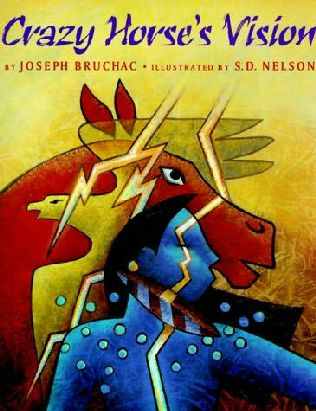
Crazy Horse's Vision by Joseph Bruchac Illustrated by S.D. Nelson

1.  Bibliography
Bruchac, Joseph.  2000.  CRAZY HORSE'S VISION.  Ill. by S.D. Nelson.  New York:  Lee & Low Books Inc.  ISBN 978880000946

2.  Plot Summary
This is a story of the life of Crazy Horse.  "Many children cry when they are born, but not Crazy Horse" (2).    His name was Curly before he had the vision that would change his name.  When he was a young boy he hunted buffalo, broke wild horses, and led his people.  "Although Curly's life as a boy was good, things were about to change" (10).  The white settlers begin to make homes in the land of the Lakota.  After a battle where one of the Native American men is wounded severely Curly decided to go to the hills and seek answers from a vision. 

3.  Critical Analysis
The setting of the story takes place in the plains where the Lakota Native Americans reside before the white settlers made they move.  The theme of the story is the life of Crazy Horse from a baby to a young man who will lead his people.
The illustrator paints the pictures in traditional ledger book style of his ancestors the Standing Rock Sioux tribe.  The artists used the following media to create this ancient style:  pencils, pens and watercolors.  The Native Americans in the pictures have many different skin colors.  They are red, brown, yellow, green, and blue.  The white settlers have only one skin color which is white.  The characters do not have any distinct facial features this is due to make the pictures meet the standards of the ancient art.  The bodies of the characters are square with strong lines.  None of the shapes are soft in the pictures they stand out and make their presence known.  The Native American and settlers wear the correct attire for the time period.  The Lakota wear loin clothes and feathers in their long dark hair and the army men wear blue and gold uniforms.  The homes are tepees and a fort for the white people.  All of the elements in the pictures go with the time period of the story and follow the rules of the traditional ledger book style of drawing.  The illustrator is conveying the message of an ancient style of art for the illustrations in the time period of the story.

The text the author as no descriptions of the characters physical attributes.  They are evident with the illustrations.  The identification of the culture in the text is through the characters names, their way of life, the name of the Native American tribe, the events that take place in the story, and religious practice.  The names of the characters in the story are Crazy Horse, Tashunka, and Chief Conquering Bear.  The story introduces the reader to the life of Crazy Horse which includes breaking horses and hunting buffalo.  "I give this buffalo to all those in our camp who have no hunt for them" (7).  The name of the Native American people the Lakota is mentioned several times in the book to let the reader know exactly who the author is talking about.  The events that happen in the story introduce the reader to how Crazy Horse's life begin before he started to lead his people.  The religious practice that is introduced in the story is vision's to find a person's way.  "What would happen now to his people?  Who would defend them?  Curly decided he needed a vision to guide him" (16).  The author provides many great cultural markers to show the reader what group of people he is talking about in this story.

4.  Review Excerpts
PUBLISHERS WEEKLY:  "As he did in Gift Horse, Sioux artist Nelson blends contemporary and traditional elements for the striking illustrations that accompany this story of the legendary Lakota warrior. Bruchac (A Boy Called Slow: The True Story of Sitting Bull) traces Crazy Horse's boyhood, zeroing in on a pivotal event in his life and highlighting an important Native American rite of passage. As a youth, Crazy Horse (then known as Curly) witnesses U.S. Army soldiers brutally and unjustly attack his people."
SCHOOL LIBRARY JOURNAL:  "PreSchool-Grade 3–Joseph Bruchac's excellent picture book (Lee & Low, 2000) about the brave Lakota warrior presents information about his youth. The beauty of the story is not quite realized in the narration by Curtis Zunigha, former Chief of the Delaware (OK) Nation. While richly voiced, he reads Bruchac's spare narrative inordinately slowly and mechanically."

5.  Connections
This is a great book to introduce children to the life of Crazy Horse before he became a legend.
Other books about Crazy Horse:
Brimmer, Larry Dane.  CHIEF CRAZY HORSE:  FOLLOWING A VISION.  ISBN 9780761430612
Freedman, Russell.  THE LIFE AND DEATH OF CRAZY HORSE.  ISBN 9780823412198
Landau, Elaine.  CRAZY HORSE:  AMERICAN INDIAN LEADER.  ISBN 0766022161 

Jingle Dancer by Cynthia Leitich Smith Illustrated by Cornelius Van Wright

1.  Bibliography
Smith, Cynthia Leitich.  2000.  JINGLE DANCER.  Ill. by Cornelius Van Wright.   New York:  Morrow Junior Books.  ISBN 068816241


2.  Plot Summary
Jenna wants to be a jingle dancer like her grandma.  She does not have any jingles for her dress, so she decides to borrow a few from each of her family members to make a jingle dress she can wear for the jingle dance.  "May I borrow enough jingles to make a row?"  Jenna asked, not wanting to take so many that Aunt Sis's dress would lose its voice"  (10).

3.  Critical Analysis

The characters in the story are a family of Native Americans.  The illustrations display the characters skin tones, facial features, clothing, hair styles, and environment to represent the Native American people.  Their skin tones are tan with long dark hair that is braided or hangs down their back.  The clothing in the story is normal for present day, except when the characters are thinking about the jingle dance.  Than the characters are wearing traditional clothes and hairstyles.  The environment in the story takes place in each characters home.  The reader can see different items in the pictures that are Native America decorations.  For example there are dream catchers, woven baskets, and portraits of Native Americans decorating the characters homes.  The pictures in the story are beautiful and realistic to give the reader a glimpse into the homes and life of a young Native American girl.
The theme of the story is sharing and relying on family to help when a dream needs to be accomplished.  There are no physical descriptions in the text about the characters due to the realistic pictures.  The text provides little hints of what type of culture is being represented in the book.  The following words are used to help identify the Native American culture; fry bread, powwow drum, jingle dancing, and Indian tacos.  The language pattern and dialect are standard for present day English.  The names of the characters hint also of the Native American culture.  The characters names in the story that represent their culture is Sun and Grandma Wolfe.  The foods in the story mentioned that are sold at the celebration are another cultural marker that represent this culture.    They are going to sell fry bread and Indian tacos at the powwow.  "Next powwow, you could dance Girls, Grandma Wolfe answered"  (3).  The story shares with the reader the preparation for the jingle dance of the Native Americans.

4.  Review Excerpts
PUBLISHERS WEEKLY:  "Smith's language consciously evokes legend. For example, "As Sun caught a glimpse of the Moon" indicates the time of day; and Jenna is careful to borrow only a limited number of jingles, "not wanting to take so many that [another's] dress would lose its voice." Van Wright and Hu's (Jewels) lifelike renderings capture the genuine affection between Jenna and these caring older women."
SCHOOL LIBRARY JOURNAL:  "Seeing Jenna as both a modern girl in the suburban homes of her inter tribal community and as one of many traditionally costumed participants at the powwow will give some readers a new view of a contemporary Native American way of life."

5.  Connections
This is a wonderful book to show children what a Native American child's lifestyle is in present day and the information about their traditions.  The book would be good to read aloud to students when learning about celebrations of the Native Americans.
Other books about Native American powwows:
Foran, Jill.  POWWOW. ISBN 1590360958
Kalman, Bobbie.  CELEBRATING THE POWWOW.  ISBN 0865056404
Mitchell, Barbara.  RED BIRD.  ISBN 0688108601
Racket, Linda.  RAINY'S POWWOW.  ISBN 08735867


Tuesday, July 12, 2011

Crossing Bok Chitto A Choctaw Tale Of Friendship & Freedom By Tim Tingle

1.  Bibliography
Tingle, Tim.  2006.  CROSSING BOK CHITTO A CHOCTAW TALE OF FRIENDSHIP & FREEDOM.  Ill. by Jeanne Rorex Bridges.  Hong Kong:  Cinco Puntos Press.  ISBN 9780938317777


2.  Plot Summary
In Mississippi there is a river named Bok Chitto.  On one side of the bank resides the Choctaws and on the other side is the plantation owners and their slaves.  If a slave crossed the river to the other side the plantation owners were not allowed to follow them.  They were free.  One day Martha Tom a Choctaw crosses the river to the other side to collect blackberries.  Underneath the water of the river was a path of stones that only the Choctaw knew existed and used it to cross the river.  She watches the slaves have church and is introduced to Little Mo.  He took her back to the river and Martha showed him the secret path of stones under the water.  The young girl and boy become fast friends.  The owner of the plantation decides to sell some of his slaves.  "The men from the slave households were called together to listen to the names being read.  Little Mo's mother was on the list" (23).  The family is devastated they decide to runaway.  "Daddy there is a way we can stay together.  We can go crossing Bok Chitto.  Martha Tom told me how"  (26).  Little Mo asks Martha's Mom to help his family cross the river and escape from slavery.

3.  Critical Analysis
The setting of the story takes place in Mississippi near the Bok Chitto River before the Civil War.  The characters in the story are a family of African American slaves, the plantation owner, and the Choctaw Native Americans.  The theme of the story is the importance of friendship no matter what culture a person is.  The specific cultures are clearly identified in the text.  The author states what type of cultures the characters are from by stating them to the reader.  For example, "A skinny black man with a cane stepped out of the trees" (4).   He mentions the Choctaw, slaves, and plantations owners to the reader.  It is crystal clear what culture they represent in the story.  There are no specific language patterns in the text.  The dialect is basic to the American language.  The only dialect of the Choctaw Native Americans is a song during a ceremony.  The celebrations and religious practices are briefly mentioned in the story for the slaves and the Choctaw people.

The illustrations in the book clearly show the skin tones, facial features, and clothing of the different cultures in the story.  The Choctaw have tan skin and dark hair.  They wear moccasins and clothes that are the appropriate dress for the time period the story takes place.  The slaves have dark skin and wear pants, shirts and dresses to be adequate with the time period.  The Choctaw have smooth long dark hair and the slaves have black curly hair that fits their culture.  The pictures are beautiful and  realistic to give the reader a glimpse into the past. 

The author and illustrator of this story clearly show each culture.  The story and images are very realistic.  This is a wonderful story that shows the emotions of the characters and the importance of freedom and the unity of all cultures.

4.  Review Excerpts
BOOKLIST remarks, "*Starred Review* Gr. 2-4. In a picture book that highlights rarely discussed intersections between Native Americans in the South and African Americans in bondage, a noted Choctaw storyteller and Cherokee artist join forces with stirring results."
SCHOOL LIBRARY JOURNAL," Tingle is a performing storyteller, and his text has the rhythm and grace of that oral tradition. It will be easily and effectively read aloud. The paintings are dark and solemn, and the artist has done a wonderful job of depicting all of the characters as individuals, with many of them looking out of the page right at readers."
American Indian Youth Literature Award Winner

5.  Connections
This would be an excellent story to read to children that are learning about slavery and Native Americans.  It shows a great example of friendship between two different cultures.
Other Choctaw stories by Tim Tingle:
Tingle, Tim.  SALTYPIE:  A CHOCTAW JOURNEY FROM DARKNESS INTO LIGHT.  ISBN 1933693673
Tingle, Tim.  WALKING THE CHOCTAW ROAD:  STORIES FROM RED PEOPLES MEMORY.  ISBN 0938317733
Tingle, Tim.  WHEN TURTLE GREW FEATHERS:  A TALE FROM THE CHOCTAW NATION.  ISBN 0874837774
 

Friday, July 1, 2011

Yum! MmMm! Que Rico! Americas' Sproutings By Pat Mora Ill. By Rafael Lopez

1.  Bibliography
Mora, Pat.  2007.  YUM! MMMM!  QUE RICO!  AMERICA'S SPROUTINGS.  Ill. by Rafael Lopez.  New York:  Lee & Low Books Inc.  ISBN 9781584302711


2.  Plot Summary
The author writes haiku's of different foods that the many different cultures have shared with each other to make them a popular addition to foods we eat everyday.  There is a haiku written about each type of food and on the side of the page is information about where the food originated and how it grows.  "Chocolate.  Fudge, cake pie, cookies.  Brown magic melts on your tongue.  Happy, your eyes dance"  (7).  This is an example of one of the many wonderful haiku's in the book.

3.  Critical Analysis
The text in this picture book is written in Haiku; which are seventeen syllable poems that come from Japan.  Information about each type of food is on the left hand side of each page.  The reader gains a better understanding of where the food came from and how it grows.  There is no plot or theme.  The author is letting the reader know where each food came from and doing a fun haiku about each item.  The setting takes place changes on every page depending where the type of food came from.  The text in the book clearly defines where each food comes from.  This is a strong cultural marker for the reader.  The book is fun to read with the haiku's and informative with the information provided about each type of food.
The illustrations in the book are bright and colorful.  The excitement of eating each type of food is evident on the characters faces.  The skin tone, facial features, body types, clothing, environment, and hairstyles change depending where the food came from.  One page can show a Native American girl with cranberries and the next can show a Mexican man eating a chile.  When the reader turns the page a different culture is shown with an exciting new environment. 

4.  Review Excerpts
SCHOOL LIBRARY JOURNAL says:  "The art conveys an infectious sense of fun, as smiling suns and moons beam down upon happy children and animals, along with a trumpet-wielding peanut-butter sandwich and a dancing pineapple. Teachers will find this a welcome addition to their social-studies units, but it should also win a broad general audience for its inventive, fun-filled approach to an ever-popular topic: food."
BOOKLIST remarks:  "This inventive stew of food haiku celebrates the indigenous foods of the Americas."

5.  Connections
This would be a wonderful book to use when introducing children to different types of foods and where they originated from.
Other books about food by Pat Mora:
Mora, Pat.  BOOK FIESTA.  ISBN 9780061288777
Mora, Pat.  LET'S EAT/ A COMAR!  ISBN 9780060850388

Off And Running By Gary Soto Illustrated By Eric Velasquez

1.  Bibliography
Soto, Gary.  1996.  OFF AND RUNNING.  Ill. by eric Velasquez.  New York:  bantam Doubleday Dell Publishing Group, Inc.  ISBN 0385321813

2.  Plot Summary
The fifth grade is having an election for class president.  Miata and her best friend Ana decide to run for office.   There goal is to clean up the school.  They want to paint over the graffiti, plant flowers, and have new computers for the students to use.  She has strong beliefs that they can win and wants to help the school.
Rudy and Alex decide that they will run against the girls for president.  Their goals are to have longer recess and eat ice cream everyday of the week, instead of just Monday.  They are funny and outgoing and the other students love their ideas and jokes.  But Miata  believes that Rudy''s goals cannot be accomplished and her could really help the school.  Who will win this race for president?

3.  Critical Analysis
The plot in the story is boy verses girl who will win the race for president of the fifth grade class.  The setting takes place in a typical suburban town in a Mexican American community.  The apparent culture markers in the text are the names of the characters, the way the authors adds the language into the text, and the food.  The author does a wonderful job sharing the Mexican American world with the reader.  The characters are smart and funny.  The reader laughs at Rudy's jokes and wants to be Miata's friend.  This  book is a strong book filled with cultural markers.  Readers of all ages can enjoy this book.
The illustrations in the book are done in black and white.  The reader can identify the characters as Mexican American due to their facial features and hair color.  The clothing and general environment of the story is the same has any American family.  The pictures give the reader a brief glimpse of the characters in the story and their emotions at certain intervals in the story.  I feel that the pictures were not necessary in the book.  The reader could already tell what the characters looked like and their natural environment from the writing of the author.  The pictures were good ,but not needed.

4.  Review Excerpts
SCHOOL LIBRARY JOURNAL review:  "A humorous, light, good-natured story about everyday life in one community that will have great appeal for kids everywhere.?"
BOOKLIST says:  "The main focus is on Miata, but Rudy often steals the show with his gross clowning. There isn't a mean character around, but the teasing humor subverts any danger of the reverential (he's not chewing gum in church, Rudy explains, it's just in his mouth).

5.  Connections
This book is a good read for students learning about growing up Mexican American.
Other books about strong willed boys and girls:
Lupica, Mike.  LONG-SHOT:  A COMEBACK KIDS NOVEL.  ISBN 9780399247170
Resau, Laura.  STAR IN THE FOREST.  ISBN 9780385737920